
Types Of Network Topology

Today, we will types of network topology.

What is a Network Topology?

Definition of Network topology is the shape of the network. It is the physical layout of connected devices in a network. It tells us how a network will look like.
Network Topology ( Definition 2): The way in which the connections are made among all the network entities is called the topology of the network.
Network Topology ( Definition 3):Network topology specifically refers to the physical layout of the network, e.g., the location of the computers and how the cable is run between them.
Network Topology ( Definition 4):The physical topology of a network refers to the configuration of cables, computers, and other peripherals.
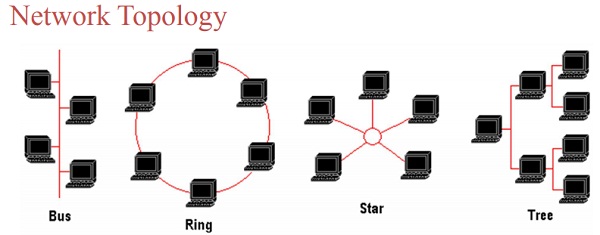
The characteristics of a network depend upon the network topology selected.
types of network topology

Explain different types of network Topology

Different network topologies are as follows:
1. Bus Topology
2. Ring Topology
3. Star Topology
4. Tree Topology
5. Mesh Topology

1. Bus Topology


types of network topology


Bus topology is the simplest network topology. In bus topology, all computers in network are connected to a common communication wire. This wire is called BUS. Terminators are used at both ends of wire.
Bus Topology - Different Types of Network Topology

2. Star Topology

Star Topology is the most popular and widely used network topology in local area networks. In star topology, all computers are connected with a central device known as HUB or Switch. Now-a-days Hubs are often replaced by Fast Network Switches. The sender computer sends data to the hub. The hub sends it to the destination computer. So, all data communication is managed through HUB or Switch.
Star Topology - Different Types of Network Topology

Note: The major difference between a Networking Hub and Networking Switch is that HUB sends data to all computers, and the destination computer will accept it while other computers will not. On the other hand, Switch sends data only to the destination computer. Therefore, switch can reduce network traffic and hence provides fast transmission speed.

3. Ring Topology

In Ring topology, each computer is connected to the next computer such that last computer is connected to the first. Every computer is connected to next computer in the ring. Each computer retransmits what it receives from the previous computer. Suppose, computer A needs to send data to computer D. Now the computer A sends data to computer B. As computer B is not the destination computer, so it will retransmit data to computer C. Finally, Computer C will transfer data to computer D, the destination computer. When a node sends a message, the message is processed by each computer in the ring. If a computer is not the destination node, it will pass the message to the next node, until the message arrives at its destination.
Ring Topology - Different Types of Network Topology


4. Tree Topology

Actually, a Tree topology is the combination of two topologies: bus and star topology. A tree topology combines the characteristics of bus and star topologies. It consists of groups of computer connected as star topology. These groups are then connected to a central communication medium (bus cable).
Tree Topology - Different Types of Network Topology

5. Mesh Topology

In a mesh topology, every device on the network is physically connected to every other device on the network. Therefore, data can be sent on several possible paths from source computer to destination computer. Mesh topology is more reliable with better performance. It is mostly used in wide area networks where reliability is important.
Mesh Topology - Different Types of Network Topology


After reading : Types of network topology


Read  More on Networking
and Networks
1 Explain
Advantages Of Networks
2 Types
Of Computer Networks
3 Differences
between LAN and WAN
4 Types
Of Network Topology
5 Bus
Topology :Advantages and Disadvantages
6 Advantages
and Disadvantages of Star Topology
7 Advantages
and Disadvantages of Ring Network Topology
8 Advantages
and Disadvantages of Tree Topology
9 Advantages
and Disadvantages of Mesh Topology

Comments

Anonymous said…
hey there and thank you for your info – I’ve certainly picked up something new from right here. I did however expertise a few technical issues using this site, since I experienced to reload the site lots of times previous to I could get it to load correctly. I had been wondering if your web hosting is OK? Not that I am complaining, but slow loading instances times will sometimes affect your placement in google and could damage your high quality score if advertising and marketing with Adwords. Anyway I’m adding this RSS to my email and could look out for a lot more of your respective exciting content. Ensure that you update this again soon..
Aquiesse Frankincense & Myrrh Candle
Admin X2 said…
Hi Gowtham!
Thanks for being here. Sure, you can share some of this stuff on your blog, but don't forget to have a link back to my blog. http://forfreeeducation.blogspot.com

Popular posts from this blog

Explain different types of storage devices

Topic: Explain different types of storage devices in Computer systems Storage Devices Storage devices are used to store data and instructions permanently. Storage devices are also called secondary storage devices / backing storage devices / external storage devices or auxiliary storage devices. Examples of storage devices include Hard Disk, CD and DVD etc. Why Secondary Storage Devices are Used? Secondary storage devices are used because: Primary memory(RAM) is volatile and temporary. When computer is switched off, all data in ram is erased. Storage devices can store large amounts of data and instructions permanently whereas Primary memory has less capacity of storing data. Types Of Storage Devices There are three main types of storage devices:  Magnetic Tape   Magnetic Disk   Optical Disk   Flash Memory storage devices 1. Magnetic Tape Magnetic tape is the oldest storage device. It is made of plastic coated with m...

What are Different Types of Computer

Computers can be divided into the following 3 types on the basis of their working mechanism: 1) Analog Computers 2) Digital Computers 3) Hybrid Computers 1. Analog Computers Analog computer is used to measure continuous values. It measures a physical property like voltage, pressure, speed, time and temperature. An analog computer takes input in analog form and gives output in analog form. Its output is usually displayed on a meter or scale. Analog computer has low memory and fewer functions. Analog computer is mainly used in the field of engineering and medicine. Examples include: Examples of Analog Computers include:  1. Thermometer 2. Speedometer 3. Analog clock 2. Digital Computers A digital computer works with digital data. Digital computer uses binary number system. Binary number system consists of only two digits 0 and 1. A digital computer represents data in digital signals. A 0 represents OFF and a 1 represents ON. Digital computer performs a...

Types Of e-Commerce

Types/Categories/Modes of e-commerce. There are three main types of e-commerce as follows: 1) Business To Consumer (B2C) B2C ecommerce consists of selling goods and services to individual consumers. In this type, consumers or customers can visit the website and purchase goods online. The website will have a StoreFront. This storefront will show product details, pictures and a shopping cart. Shopping cart is used to collect items to purchase. Advantages of B2C e-commerce B2C e-commerce has the following advantages: * Shopping can be faster and more convenient. * Offerings and prices can change instantaneously. * Broadband telecommunications will enhance the buying experience. 2) Business To Business (B2B) B2B e-commerce takes place between two businesses. One business provides services to other business. Examples of B2B include: Online Advertisement, recruiting, sales, marketing, technical support and training. For eample, some companies provide online purchasing...