Create Your First Web Page in HTML

Today, we will discuss the topic Create Your First  Web Page in HTML. As we know a website is a set interlinked related web pages. Therefore, to design and develop a website, we need to know creating web pages. HTML stands for Hyper Text Markup Language. HTML is the basic language used to create web pages.
Let's start our tutorial with suitable pictures Create Your First  Web Page in HTML.
Now we will create a simple web page to display some text like "Welcome to Web Page Development!" and with a title "My First Web Page".


1. Type HTML Code in Note Pad

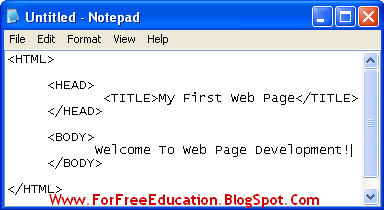
Open Note pad and type the following HTML code.
<HTML>
<HEAD>
<TITLE>My First Web Page</TITLE>      
</HEAD>
<BODY>
Welcome To Web Page Development!
</BODY>
</HTML>

Picture: Create Your First  Web Page in HTML in 5 minutes
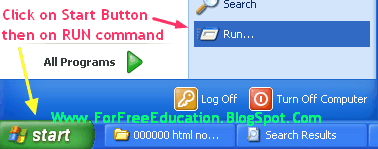

Create Your First  Web Page in HTML Easily - Instructions with Pictures


How to Create Your First  Web Page in HTML


Picture: Create Your First  Web Page in HTML Easily

How to Create Your First  Web Page in HTML Easy Tutorial


2. Save HTML Document with HTML extension

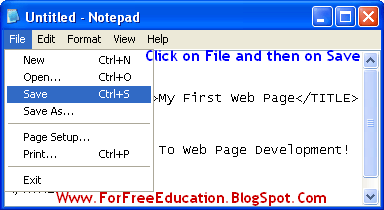
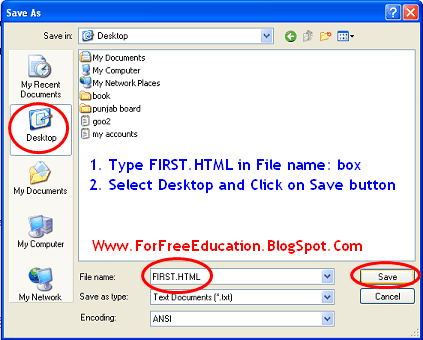
Save this file as "FIRST.HTML". Click on File menu, click on Save, Type "FIRST.HTML" in file name box, select Desktop as a location to save, click on Save Button.

Create Your First  Web Page in HTML

Picture: Create Your First  Web Page in HTML Made Easy

Easy Tutorial Create Your First  Web Page in HTML

3. View Your Web Page in Web Browser

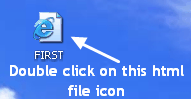
You will see that the file will be saved with a blue "e" Internet Explorer icon. Double click on the file and view the resulting web page in internet explorer window. You can see the pictures given to learn web page creation easily:

Create Your First  Web Page in HTML in 5 minutes


Picture: Create Your First  Web Page in HTML ( Final Product = The Output )
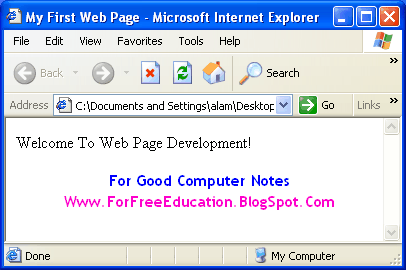
Made Easy Create Your First  Web Page in HTML in 5 minutes

Comments

Popular posts from this blog

Bus Topology Advantages Disadvantages

Bus Topology Bus topology is the simplest network topology . In bus topology , all computers in network are connected to a common communication wire. This wire is called BUS. Terminators are used at both ends of wire. Bus Topology is Cheap, easy to handle and implement. Bus Topology require less cable. Bus Topology is best suited for small networks. Working of Bus Topology with Advantages and Disadvantages Advantages of Bus Network Topology 1. It is very simple topology . 2. It is easy to use. 3. It needs small amount of wire for connecting computers. 4. It is less expensive due to small wire needed. 5. If one computer fails, it does not disturb the other computers in network. Other computers will continue to share information and other resources with other connected computers. Disadvantages of Bus Network Topology 1. Only small number of computers can be connected in a bus network . 2. Network speed slows down as the number of computer increases in b...

Explain Different Types Of Data

DATA Data is the collection of raw facts and figures. It is without any proper meaning. Data may be collection of words, numbers, graphics or sounds. What is data? Explain different types of data Examples of Data 1) Student Data on Admission Forms When students get admission in a college. They fill admission form. This form     contains raw facts (data of student) like name, father’s name, address of student etc. 2)    Data of Citizens During census, data of all citizens is collected. 3)    Survey Data Different companies collect data by survey to know the opinion of people about their product. 4)    Students Examination data In examination data about obtained marks of different subjects for all students is collected.    Different Types Of Data There are following main types of Data. 1)    NUMERIC DATA Numeric data consists of 0 to 9 digits, + and – sign and dec...

Explain Main Difference Between System Software and Application Software

Topic: Explain Main Difference Between System Software and Application Software            Differentiate between system software and application software Before , explaining the main differences between application software and system software, let us know the definitions of Application software and System software with examples. What is System Software: System software is a set of programs to control all components of computer and to manage overall operations of computer system. Differences between System software and application software System software is used as a base to install and run all application software. Examples of system software include: Operating Systems, like Microsoft Windows, DOS, Unix and Linux Device Drivers like Device driver software of a Printer (found on CD normally provided with the printer) Utility Programs like AVAST anti virus, Disk Scanners and File Viewers etc. What is Applicat...