
Practical Use of SUM Function in Excel Worksheet

What is SUM Function?

The SUM Function is used to add all numbers in a given range of cells and returns the total as a result. The syntax of the SUM Function is as follows:

Syntax 1 of SUM Function in Excel wWorksheet:

 SUM(FirstCell : LastCell)

where FirstCell is the cell reference of the first cell in cell range and LastCell is the cell reference of the last cell in the given cell range to be added.
 For Example: If cells A1,A2,A3,A4 contains 10,20,30,40 respectively then the function =SUM(A1:A4) will give 100.

Learn Practical  Use of SUM function in MS Example with examples
Simple Use of SUM function in MS Example with examples

Syntax 2 of SUM Function in Excel Worksheet:

  SUM(number1, number2, number3, ..., number N)
    For Example:
= SUM(10,20,30)
will give the result 60.   and  = SUM(2,5) will give 7.

Syntax 3 of SUM Function in Excel Worksheets:

 SUM(cell1, cell2, cell3, . . ., cell N)
Where cell1, cell2, cell3,...cell N are the cell references of the cells containing numbers to be added.
 For Example: =SUM(A1, A3,A5) will give 10 if cell A1, A3, A5 have 2,3,5 respectively.
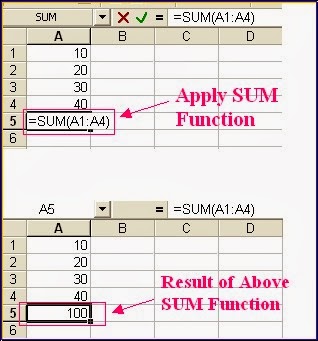
Practical  Use of SUM function in MS Example with examples


There are some more possibilities to use the SUM function as following:
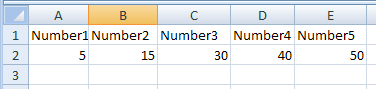
How To Use SUM Function in Excel worksheet

If cells A2:E2 contain 5, 15, 30, 40, and 50 as show in above Excel Worksheet image:  
SUM(A2:C2) equals 50        because 5+15+30
and SUM(B2:E2, 15) equals 150    because 15+30+40+50   and +15

If A1:A4 contains 10,20,30,40 respectively and cell A5 contains a non numeric value like "Excel" then the function = SUM(A1:A5) will return 100 because it ignores non-numeric value in Cell A5 that is Excel.

Example How to Use SUM Function in Excel worksheet

Comments

Popular posts from this blog

Explain Main Difference Between System Software and Application Software

Topic: Explain Main Difference Between System Software and Application Software            Differentiate between system software and application software Before , explaining the main differences between application software and system software, let us know the definitions of Application software and System software with examples. What is System Software: System software is a set of programs to control all components of computer and to manage overall operations of computer system. Differences between System software and application software System software is used as a base to install and run all application software. Examples of system software include: Operating Systems, like Microsoft Windows, DOS, Unix and Linux Device Drivers like Device driver software of a Printer (found on CD normally provided with the printer) Utility Programs like AVAST anti virus, Disk Scanners and File Viewers etc. What is Applicat...

HTML Table Tag Basics

Tables Tables are very important to show data in the form of rows and columns. Tables make data more readable and easy to understand. A table consists of rows, columns and cells. HTML Tags To Make A Table As we know that there are basically three elements in a table, that is, rows, columns and cells. So, there are the following basic tags to create a table in an HTML web page: <TABLE> tag <TR> tag <TD> tag <TH> tag   <TABLE> Tag <Table> tag is used to specify the start of a table. It also specifies some attributes of the table like ALIGN and BORDER attributes etc. Example 1: <Table>                    => Table without a border. Example 2: <Table border="1">     => Table with a border of width 1. Example 3: <Table align="left" border="2">  => A left aligned Table with a border of width 2. ...

Computer Hardware Test Interview VIVA

Q1. Define Hardware. What are different types of hardware? The physical parts of a computer are called hardware. Hardware can be touched or seen by us. Different types of hardware components are as follows: Input devices (keyboard, mouse, scanner, digital camera etc.) The Central Processing unit (CPU/Processor) Output devices (monitor, printer, plotter, speaker, data projector etc.) Memory chips (RAM, ROM etc.) Storage devices (hard disk, Floppy disk, CD, DVD etc.) Q2. Define Input devices. INPUT DEVICES:Input devices are used to enter data and instructions into computer memory from external world. Examples include: Keyboard, Mouse, Track ball, Track Pad, Joy stick, Touch Screen, Light pen, Touch Screen, Scanner, Digital Camera, Microphone, Q3. Define Output device. Output devices:Out put devices are used to display results of processing to the user. They perform the following functions: Examples include: Monitor, printer, plotter, speaker Pr...